 Opinion
This article reflects my personal views and analysis. It is provided for general informational and academic discussion purposes only. It does not constitute legal advice, does not create an attorney–client relationship, and should not be relied upon as a substitute for legal counsel. I maintain an ownership interest in ChildSafe.dev™ and RoseShield™.
I've been making the case that, once the evidence of foreseeable risk becomes too voluminous to ignore, the legal system begins to shift. Sometimes slowly. Sometimes more quickly. Recent events suggest we may now be crossing into the “more quickly” phase.
A note of warning: I'm writing from an interpretive, reflective place and cautious about certainty. I'm aware that what I believe today may be refined tomorrow. But as I see it today, there is a pattern that is becoming harder to miss.
In the past weeks, OpenAI announced its support for California’s proposed AI safety legislation—a move that would have been unthinkable for a frontier model developer even 18 months ago. The company described the bill as a “balanced and necessary framework” for ensuring responsible deployment. This matters because industry leaders rarely support stronger regulatory obligations unless they see the inevitability—or the opportunity—created by doing so. It is an indicator of where the center of gravity is shifting.
Around the same time, Utah took steps to restrict access to Character.AI after concerns that minors were being drawn into explicit or simulated sexual role-play scenarios. State officials framed it not as censorship, but as a failure of architecture to prevent foreseeable child harm. This signals another trend: it looks like regulators are no longer asking whether harm happened; they may be moving towards asking whether harm was predictable and whether reasonable safeguards were ignored.
Didomi’s 2026 privacy trends analysis notes a broad pivot toward:
These trends align almost perfectly with emerging safety-by-design expectations. Privacy and safety, once treated as competing values, are now converging around the same architectural truth: systems that observe less, retain less, and centralize less inherently reduce both exposure and liability.
In my recent article, The Erosion of Section 230 Immunity and the Rise of Safety-By-Design, I argued that the next decade of litigation will turn on four pillars long known to tort lawyers:
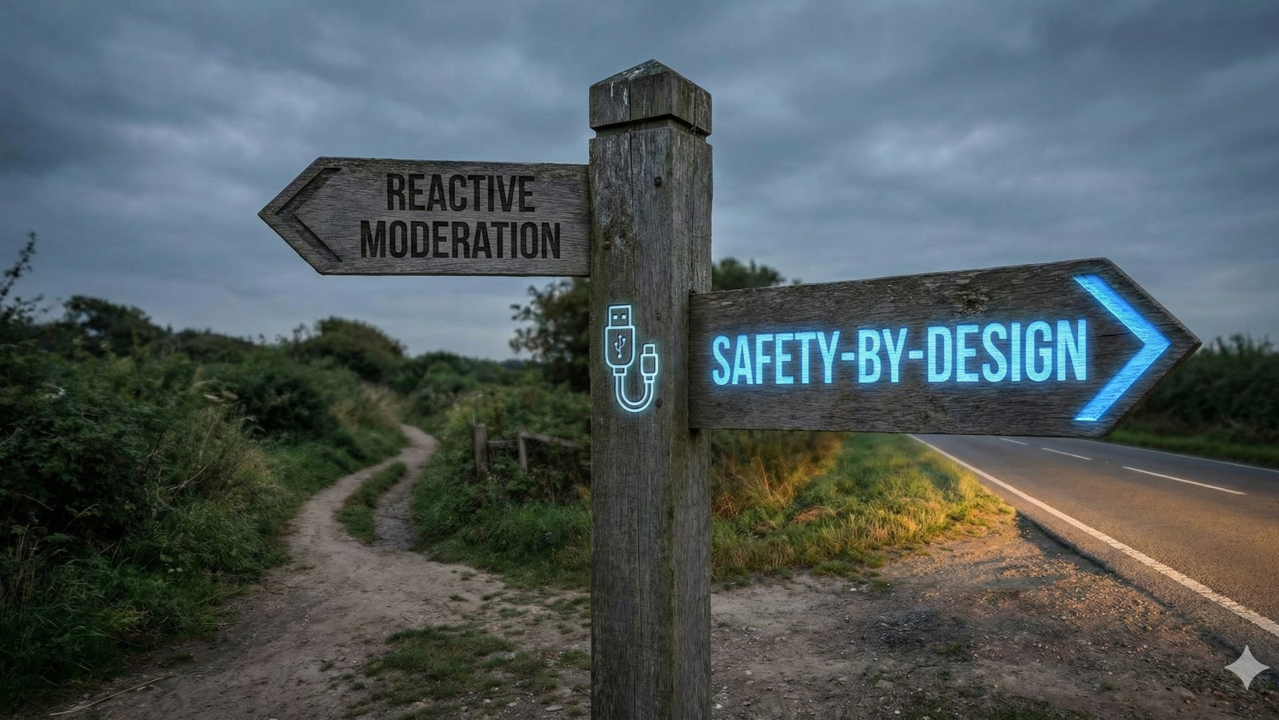
Once foreseeability is established—and it largely has been in the context of harm to children—the legal inquiry shifts from content to conduct. I don't believe that State actions like Utah’s and industry moves like OpenAI’s are isolated datapoints. Rather, I think they are part of the same structural truth: system design is becoming the new center of accountability. Whether policymakers call it “product liability,” “duty of care,” “safety by design,” or “reasonable safeguards,” the analytical frame is coalescing.
ChildSafe.dev™ and RoseShield™, which I work on, are not the only safety-by-design tools in the world. But they are examples of a class of preventive, privacy-preserving infrastructures that demonstrate what is technologically feasible without requiring content scanning, surveillance, or centralized personal data. Why this matters:
I believe safety-by-design will become the default expectation for any platform accessible to minors—and for many that are not. Not because lawmakers demand it, but because the litigation risk of ignoring it will become commercially intolerable.
Jewish rabbinic tradition often teaches through careful interpretation of evolving evidence. The goal is not to declare a single immutable truth, but to understand how wisdom shifts as new facts appear. Viewed through that lens, the last six months feel like a turning of the page—not the end of a chapter, but the beginning of a new one.
This looks to me like responsibility is finally meeting reality.
I see platforms continuing to rely solely on content moderation facing the greatest exposure. Platforms that redesign their systems now—minimizing centralized data, deploying on-device safeguards, and adopting child-appropriate architecture—will be best positioned to navigate the next decade.
My Opinion: The window to choose between architecture and liability is closing. Those who wait for the courts to decide for them will not like the result. What comes next will be shaped not only by law and policy, but by technical choices made today. The question is no longer whether harm is foreseeable. It is whether reasonable, privacy-preserving safeguards were available—and whether they were deployed.



Privacy first child protection technology. Keeping children safe online without compromising privacy.


© 2025 ChildSafe.dev · ChildSafe.dev Inc.. All rights reserved.
Built with privacy-first, PII-free child protection.


