 Safety
The latest international research on online child sexual abuse material (CSAM) prevention delivers a message that should no longer be ignored: prevention works when it is timely, intentional, and designed into the digital environment. The evidence summarized in the newly released report confirms what practitioners, researchers, and law enforcement have observed for years—intervening at moments of risk can disrupt harmful behavior, deter escalation, and open pathways to help-seeking. But the report also exposes a hard truth. Despite years of study and promising results, implementation across platforms remains uneven, fragmented, and largely opaque. Children continue to encounter risk not because we lack knowledge, but because we have failed to translate evidence into scalable, systemic action. That gap is where harm persists—and where leadership is required.
Most digital safety approaches still rely on reactive architectures. Content is flagged after upload. Images are removed after circulation. Accounts are suspended after damage is done. While these measures are necessary, they are fundamentally defensive. They respond to harm rather than preventing it.
The report underscores a critical insight: the most effective interventions are situational. Warning messages delivered in real time—when a user is searching, uploading, or engaging in high-risk behavior—can interrupt momentum and change outcomes. Randomized controlled trials and real-world deployments consistently show reductions in CSAM-related engagement when these interventions are deployed thoughtfully. Yet today, these protections are:
Children do not move through the internet in silos. Our safety systems still do.
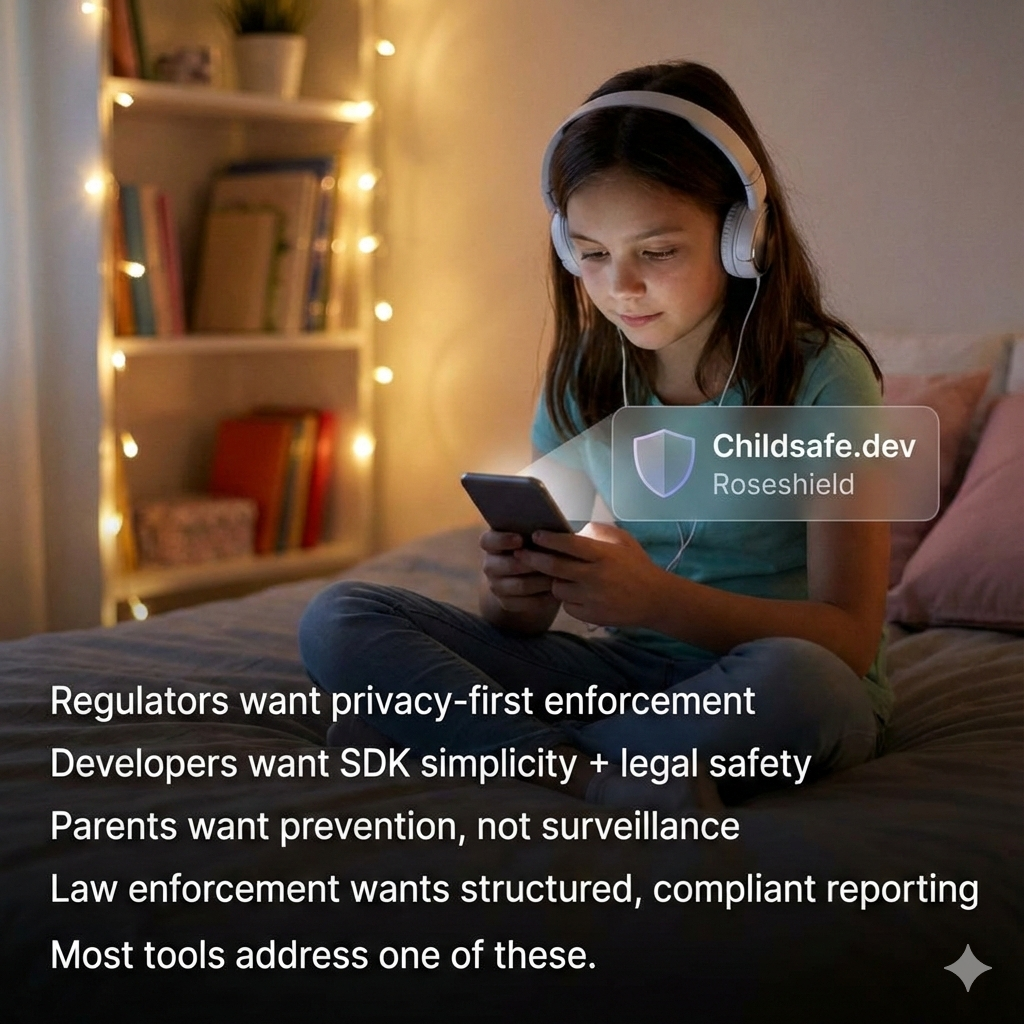
The evidence points toward an unavoidable conclusion: prevention must move closer to the point of action. That requires a shift in architecture, not just policy. ChildSafe.dev and RoseShield were designed to meet this challenge head-on. By using on-device AI, they enable real-time detection of risk signals before harmful content is created, shared, or stored—without exporting personal data or compromising privacy. This approach directly addresses the implementation failures identified in the report:
RoseShield extends this protection across the digital environments children actually use—games, social platforms, educational tools, and creative spaces—creating continuity where fragmentation has long prevailed.
One of the most important findings in the report is that deterrence and support are not mutually exclusive. Messages emphasizing illegality and traceability deter behavior. Messages emphasizing confidentiality and help-seeking enable change. The challenge is delivering the right response at the right moment. That is not a messaging problem. It is a systems problem. ChildSafe.dev operationalizes the report’s recommendations by integrating behavioral science, ethical AI, and safety-by-design into a unified framework. Rather than forcing each platform to reinvent prevention independently, it provides a proven, deployable architecture that fulfills duty of care obligations in practice—not just in principle.
The report calls for greater collaboration, transparency, and evidence-based deployment. Those are necessary steps. But they are no longer sufficient. The scale and speed of online harm demand solutions that are proactive, interoperable, and built for the environments children actually inhabit. Incremental adoption leaves gaps. Gaps are where children are harmed. On-device prevention does not replace law enforcement, regulation, or platform accountability. It strengthens all three by stopping harm earlier, reducing downstream trauma, and allowing enforcement resources to focus where they are most needed.
We now have robust research, international consensus, and clear design principles for effective prevention. The remaining question is not whether early intervention works, but whether we are willing to deploy it at scale. ChildSafe.dev and RoseShield exist to close the gap the report so clearly identifies—to turn evidence into embedded protection, and policy into practice.
Protecting children online does not require sacrificing privacy, innovation, or freedom. It requires the courage to choose architectures that prevent harm rather than merely respond to it. The evidence is clear. The technology is ready. The responsibility is ours.



Privacy first child protection technology. Keeping children safe online without compromising privacy.


© 2025 ChildSafe.dev · Carlo Peaas Inc. All rights reserved.
Built with privacy-first, PII-free child protection.


