 Product Design
I came upon this opinion piece by Irit Touitou, CEO of the Center for Educational Technology in the Jerusalem Post a few days ago titled, Navigating the Digital World: A parent's guide to online safety." I saved it with the intention of thinking through how our platforms could be most helpful in an academic setting.
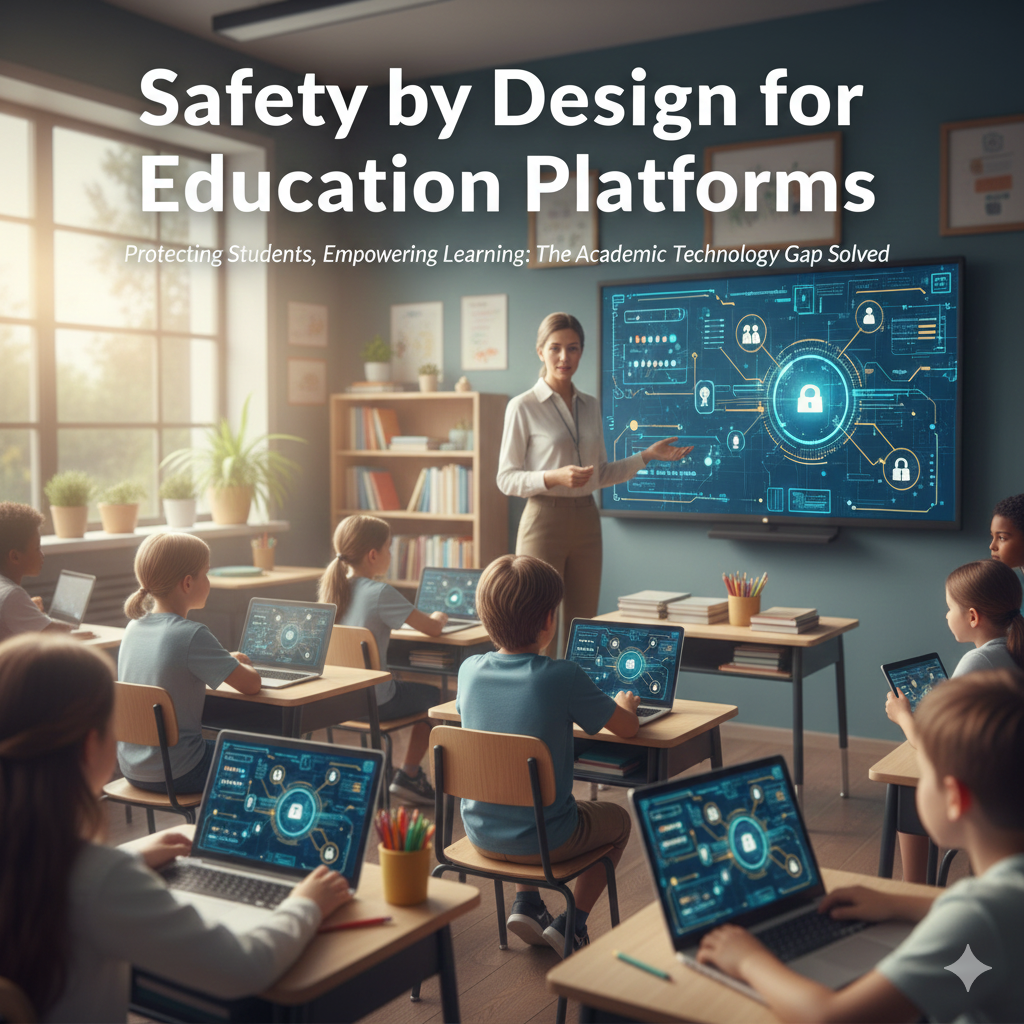
The piece highlights a reality educators across the globe are wrestling with: digital tools are now inseparable from modern education, yet the environments in which students learn online were largely designed for adults, commercial engagement, and scale—not for children, classrooms, or cognitive development. Teachers are asked to integrate technology, parents are asked to trust it, and students are expected to thrive within it. Too often, the safety infrastructure simply isn’t there.
This is not a failure of educators. It is a design problem.
Educational platforms now routinely include features that mirror consumer social products: messaging, collaboration spaces, file sharing, discussion feeds, and AI-assisted tools. These features are powerful for learning—but they also introduce risks:
Most schools and universities address these risks through policies, acceptable-use agreements, and after-the-fact moderation. But policies do not scale, and educators should not be expected to act as real-time trust and safety teams.
The Jerusalem Post opinion piece underscores a critical insight: we cannot realistically monitor everything students encounter online. What we can do is design systems that protect them by default.
This is where ChildSafe.dev and RoseShield offer a fundamentally different approach—one that aligns with the needs of academic institutions and the responsibilities of education technology developers.Rather than relying on surveillance, reporting, or post-hoc enforcement, these platforms are built around safety-by-design principles that integrate protection directly into the technology layer.
1. Real-time protection in collaborative learning tools
Many learning management systems and educational apps include group chats, project spaces, and discussion boards. RoseShield can detect and block harmful language, coercive behavior, grooming patterns, and inappropriate content as interactions occur, reducing harm before it escalates.
This is particularly important in:
2. Privacy-first architecture aligned with education standards
Educational institutions operate under strict data protection requirements. ChildSafe.dev’s on-device processing means safety decisions can be made locally, without exporting student data to external servers. This significantly reduces exposure under FERPA, COPPA, GDPR-K, and similar frameworks—while still providing strong safeguards.
In practical terms, this allows developers to:
3. Age-aware safeguards without fragmented platforms
Many academic platforms serve a mixed-age population. With ChildSafe.dev, developers can apply stronger, age-appropriate protections automatically when a user is identified as under 18—without requiring separate applications or degrading the learning experience for older students.
This is especially valuable for:
4. Shifting safety responsibility away from educators
Perhaps most importantly, safety-by-design tooling reduces the operational burden on teachers and administrators. Educators should be focused on instruction, not content moderation or incident triage. When protection is built into the platform itself, institutions gain consistency, auditability, and peace of mind.
Education is increasingly digital, global, and asynchronous. Regulatory expectations are rising, parental scrutiny is increasing, and students are spending more time learning—and socializing—inside digital systems. The lesson from the Jerusalem Post opinion piece is not that technology should be removed from education. It is that unprotected technology undermines learning outcomes, student well-being, and institutional trust. Developers serving the education sector now have an opportunity—and a responsibility—to build better defaults. Safety and privacy are no longer optional enhancements. They are core components of educational quality. For those building platforms for classrooms, campuses, and lifelong learning, ChildSafe.dev and RoseShield provide a way to meet this moment: protecting students, respecting privacy, and enabling innovation—by design, not by exception.



Privacy first child protection technology. Keeping children safe online without compromising privacy.


© 2025 ChildSafe.dev · Carlo Peaas Inc. All rights reserved.
Built with privacy-first, PII-free child protection.


