 Safety
I just finished The DNA of Democracy by Richard C. Lyons, and it sparked a thought I can’t shake as the year closes: we are living through a familiar kind of turbulence—one that societies experience when power consolidates faster than governance can adapt.
In the late 12th and early 13th centuries, England was gripped by instability that was not simply political drama; it was a structural problem. Institutions were lagging behind the behavior of power. And the people most affected—landholders, merchants, clergy, ordinary families—were forced to recognize an uncomfortable truth: rights are not granted by goodwill; they are secured by constraints on unchecked authority.
We are in a different century, and our power centers look different. But the pattern is recognizable.
The build-up to the Magna Carta was not a sudden awakening. It was the culmination of years of escalating strain: legitimacy crises, financial extraction, arbitrary enforcement, and the sense that the crown had become unbound from accountability.
King John’s reign sits at the center of this story not because he was uniquely evil in the abstract, but because he became the symbol—and instrument—of an emerging imbalance: concentrated power with inadequate constraint. Heavy levies, coercive legal practices, and retaliatory governance created conditions where “custom” and “fairness” no longer offered protection. The machine of authority could be turned on a person or family with little recourse.
That’s the point Lyons pushed me toward in modern terms: democracy is not just values. It is mechanisms—guardrails, incentives, checks—that prevent any one actor from becoming the entire system.
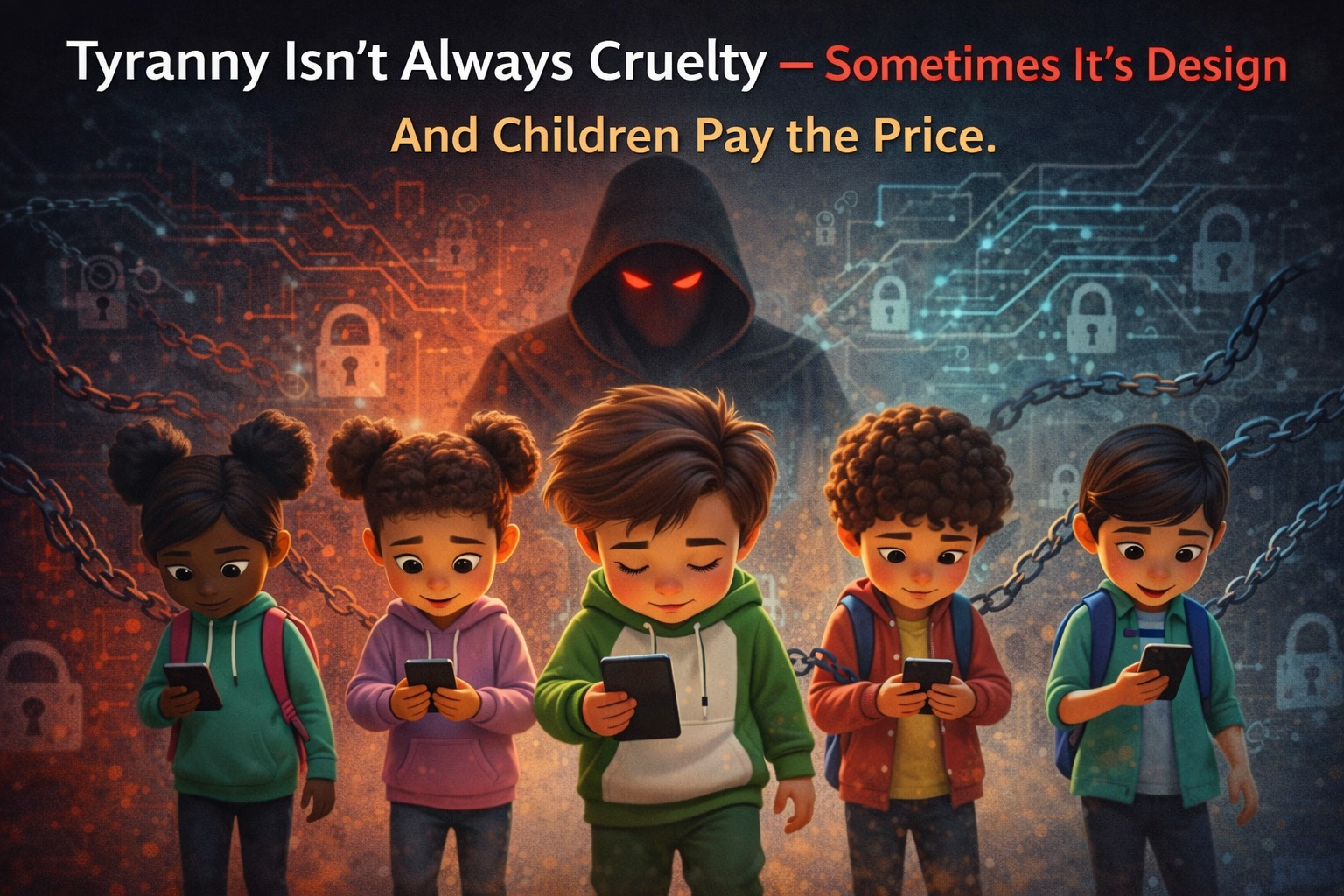
In 2025, we watched a parallel imbalance: platforms that mediated childhood at scale—attention, identity, relationships, sexuality, commerce, even emotional development—operating with governance frameworks that remain inconsistent, fragmented, and often reactive.
Children have become the most exposed “citizens” of the digital world—without meaningful representation in how that world is built.
Years before John’s conflict with the barons, England experienced a profound legitimacy crisis during the struggle between King Stephen and Empress Matilda—often remembered through the lens of Matilda’s escape from Oxford and the broader period known as “The Anarchy.” The details are medieval, but the principle is modern: when legitimacy is contested and authority is unstable, people suffer. Rules become local. Enforcement becomes inconsistent. Opportunism thrives.
In digital life, we are experiencing a form of legitimacy crisis too—not over who wears a crown, but over who gets to set the rules for childhood online.
Is it legislatures? Courts? App stores? Platforms? Parents? Schools? International regulators? All of them claim partial authority, and none can enforce coherently across borders. The result is a patchwork where safety depends on geography, platform choice, parental time, and a child’s luck.
That’s not governance. That’s volatility.
When people say “tyranny,” they often mean cruelty. But historically, tyranny is also procedural: power that is unconstrained by predictable rules, due process, or accountability.
In the medieval context, it looked like arbitrary punishment, extractive taxation, and legal systems that served authority rather than justice.
In the digital context, it can look like:
The modern twist is scale. Medieval abuses were devastating but geographically bounded. Digital harms propagate instantly and globally, and children bear a disproportionate share of the cost.
The Magna Carta did not create modern democracy. It did something more foundational: it began to formalize the idea that power must be limited by enforceable commitments—that rulers must be bound to standards, and that certain rights cannot be overridden at convenience.
In other words, it was a pivot from “trust us” to “show us.”
This is precisely where we are headed in child safety and digital governance. Around the world, governments are moving toward “duty of care” approaches, age-appropriate design expectations, and stronger requirements for platforms to prevent foreseeable harm.
But we should be honest about a second truth:
legislation will never be fast enough, uniform enough, or technically specific enough to protect children in real time.
Which brings us to the question that feels most urgent at the close of this year:
If the rules are still forming, how do we protect children now?
The answer, I believe, is that the next phase of child protection online will not be won by policy alone. It will be won by architecture.
Safety-by-design must become a baseline capability—an infrastructure layer—so that protection is not dependent on:
This is the thesis behind what we’re building: ChildSafe.dev and RoseShield as a compliance and safety engine that operationalizes protection at the point of interaction, without turning childhood into a surveillance project.
The difference between medieval constraints and modern constraints is implementation. Medieval barons negotiated parchment. We negotiate code.
And code, unlike parchment, can operate at speed, at scale, across borders—if we design it to.
The Magna Carta was born from conflict, fear, exhaustion, and a shared recognition that the status quo was unsustainable. It did not solve everything. It didn’t even solve most things immediately. But it marked a turning point: society began insisting that power be accountable.
That is where I see us heading.
In 2026, we will continue to argue over the shape of regulation, the boundaries of free speech, the role of encryption, the obligations of platforms, and the economics of the attention market. The debates will be loud, imperfect, and sometimes cynical.
But beneath that noise is a clear, emerging consensus:
Children’s safety cannot be optional.
And platforms cannot be immune from the foreseeable outcomes of the systems they design.
Lyons’ The DNA of Democracy helped me name what I was sensing: durable progress doesn’t come from good intentions; it comes from enforceable mechanisms.
Our task now is to build those mechanisms—legally, culturally, and technically—so that children do not have to wait for history to catch up.
If 1215 was a line in the sand for political power, then 2026 must become a line in the sand for digital power.
Not because we fear technology.
But because we refuse to accept a future where childhood is collateral damage.



Privacy first child protection technology. Keeping children safe online without compromising privacy.


© 2025 ChildSafe.dev · Carlo Peaas Inc. All rights reserved.
Built with privacy-first, PII-free child protection.


